What One-Star Floor Coating Reviews Complain About
Last updated: By EpoxyFloorIndex Research Team
One-star reviews of Greater Toronto Area (GTA) floor coating companies are rare. They make up 144 of the 6,307 Google reviews in this index. The complaint themes cluster around three problems: the finish, reaching the company afterwards, and the schedule. Each one can become a written question or a contract line before you hire.

How often do GTA floor coating companies get one-star reviews?
Not often. The index holds 6,307 Google reviews across its 221 companies. Of those, 6,069 are five-star, 62 are four-star, 16 are three-star, 16 are two-star and 144 are one-star. Reviews gather at the two ends of the scale, so the middle of a company's record is usually close to empty.
The 144 one-star reviews sit on 60 companies. That leaves 141 of the 201 rated companies with no one-star review at all. The spread across the 60 is uneven:
- Exactly one one-star review appears on 33 companies.
- One or two appear on 44 companies.
- Five or more appear on 8 companies, and those 8 hold 61 of the 144.
So a one-star review on its own is a common event for a busy company. A cluster of them is not. The site's methodology page says its review data is Google's, "not ours, so they carry Google's own biases."
What do the stored one-star reviews actually say?
They describe the same three problems the tags pick up. The index keeps the full text of 33 one-star reviews, spread over 26 companies, among its 1,172 stored review texts. Read without company names, a few stand out. A basement owner wrote that "hundreds of air bubbles emerged in the floor and dried that way" after the crew finished. A workshop owner wrote, "Within a week the cracks and chips started to form," and said the company "never responded to our calls or emails." Another reviewer said a company promised front stairs that would not turn slippery, and that they are now "like a slip and slide when wet." Each is one customer's account, and the site has not checked any of them.
The EpoxyFloorIndex Research Team read all 33 and sorted them by what they describe. A text can fall under more than one heading, and the sorting is the team's judgement. By that count, 21 describe a defect in the finished work, such as bubbles, peeling, cracks or an incomplete coat. Another 13 say the company stopped answering or did not come back after the job, 7 say a warranty or guarantee was not honoured, and 6 describe a no-show, a long delay or a cancelled start. At least 9 of the 33 are about work other than a coated indoor floor, such as driveways, pools or a supplier's return policy.
Does a one-star review pull a company's rating down?
Usually very little. Of the 60 companies with at least one one-star review, 45 still average 4.5 stars or higher, and 32 average 4.8 or higher. Eight of them still display a 5.0 on Google, where enough five-star reviews round the average up to a perfect score.
At the low end, the link is tighter. The index holds 15 rated companies below 4.5 stars, and every one of those 15 has at least one one-star review. Larger records collect more of them. Of the 32 companies with 50 or more reviews, 23 carry a one-star review. That applies to only 18 of the 119 rated companies with fewer than 20 reviews. How much weight a star average deserves is covered in the guide on vetting a GTA floor coating contractor. For complaints, the useful move is to read what the low reviews say and look for repeats.
Which complaints do the review tags pick up?
The site keeps a data file of review themes, called tags, built by reading the Google review text stored on each company's record. Three tags describe problems. A finish-problems tag sits on 16 companies, a hard-to-reach-afterwards tag on 11 and a slow-or-missed-schedule tag on 9. Together they cover 23 companies, and 21 of those 23 also have a one-star review.
The shapes overlap. Ten companies carry both the finish tag and the hard-to-reach tag, a pairing that fits a finish complaint nobody came back to fix, though the tags alone cannot show the order of events. Three carry finish problems plus a missed schedule, and 12 companies carry two or more of the three tags.
Read the tags with their limits in mind:
- The file is marked advisory only. A tag reads review text, counts once per company and is not a check of the company.
- Each record stores a sample of up to eight reviews, so a tag can miss a complaint.
- Only 158 of the 221 companies carry any tag at all.
- Two companies carry a problem tag while showing no review below five stars. A tag and a star count measure different things.
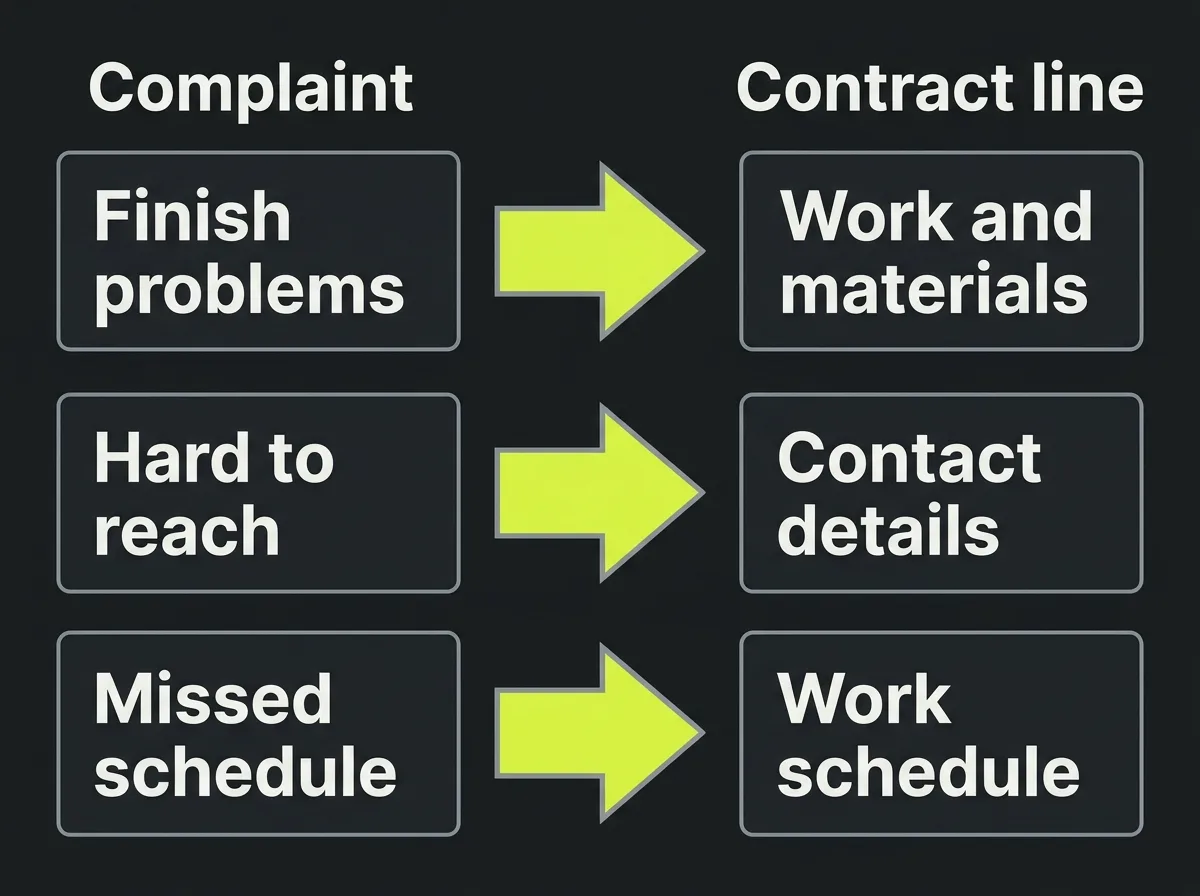
| Complaint tag (file label) | Companies | Question to ask in writing | Contract line from Ontario's checklist |
|---|---|---|---|
| finish-problems-reported | 16 | What prep, products and coats are included, and what happens if the finish fails? | "a thorough description of the project with details of the work to be done and the materials to be used" |
| hard-to-reach-afterwards | 11 | Who do I contact after the job, and how are disputes handled? | "the contractor's name, address and contact information" |
| slow-or-missed-schedule | 9 | What are the start and completion dates, and when is each payment due? | "a work schedule, including start and completion dates" |
How do you turn a finish complaint into a contract line?
Put the work and the materials in writing, in detail. The Government of Ontario's page on starting home renovations or repairs lists what a contract should include. One item is "a thorough description of the project with details of the work to be done and the materials to be used." Another is "a clear description of any warranties."
For a coated floor, that means asking before you sign. How will the slab be prepared? Which products go down, and how many coats? What does the warranty cover if the coating peels or lifts, and for how long? The guide to reading an epoxy floor quote lists the line items to look for. The guide on how long a garage floor coating lasts covers where coatings tend to fail and what warranty wording to read closely.
The same Ontario page adds a caution about timing. It says problems do not always show up at once, and gives roofing and paving as its example of work where trouble can appear "for about a year or more after a project is done." That is why it asks for references "both from the recent past and further back in time."
How do you protect yourself from a contractor who goes quiet?
Get the contact details and the dispute process into the contract before any money moves. Ontario's checklist puts "the contractor's name, address and contact information" first on its list of contract contents. The page also tells homeowners to "talk to your contractor about how you will deal with any disagreements or disputes," and adds, "Ideally, this should be addressed in your contract."
Ontario also suggests a local company for a practical reason. Its page says a local firm "may make it easier to check references, enforce a warranty or have follow-up work done." It also says one operator "may run several businesses or change a business' name." For that reason it points readers to Ontario's Consumer Beware List, a public register of complaints and charges, and to search both the business name and the operator's name.
EpoxyFloorIndex cannot help with that step. The listings show no email address and no phone number, so the direct route to a company is its own website. The quote form linked from each profile goes to EpoxyFloorIndex, which passes the job to one of the highest-scoring companies in your area, not necessarily the one you were viewing. Ask the company, in writing, who handles calls after the job is finished.
What contract terms cover a missed schedule?
Dates and a payment schedule. Ontario's checklist asks for "a work schedule, including start and completion dates" and "a payment schedule, including the deposit amount." With both in writing, a slipped start date becomes a question about a signed term rather than a matter of memory.
Ontario sets out two rules on payment:
- Keep down-payments small. The page says to "keep down-payments to a minimum" and recommends no more than 10%.
- Hold back the balance. It says to "never pay the full amount of the contract before the work is done," so the contractor has a reason to finish.
Its scam section adds that "legitimate home renovation companies have enough credit to buy the materials they need." A request for a large deposit to buy materials is worth a second look.
What does Ontario's 10% estimate rule mean for a coating quote?
It caps how far the final bill can drift, but only if the estimate is part of the contract. Ontario's page states that "if an estimate is included as part of a home renovation contract, the final price for all goods and services cannot be more than 10% over the original estimate unless you have agreed to new work or a new price." It tells homeowners to "insist that the written estimate is included in your contract."
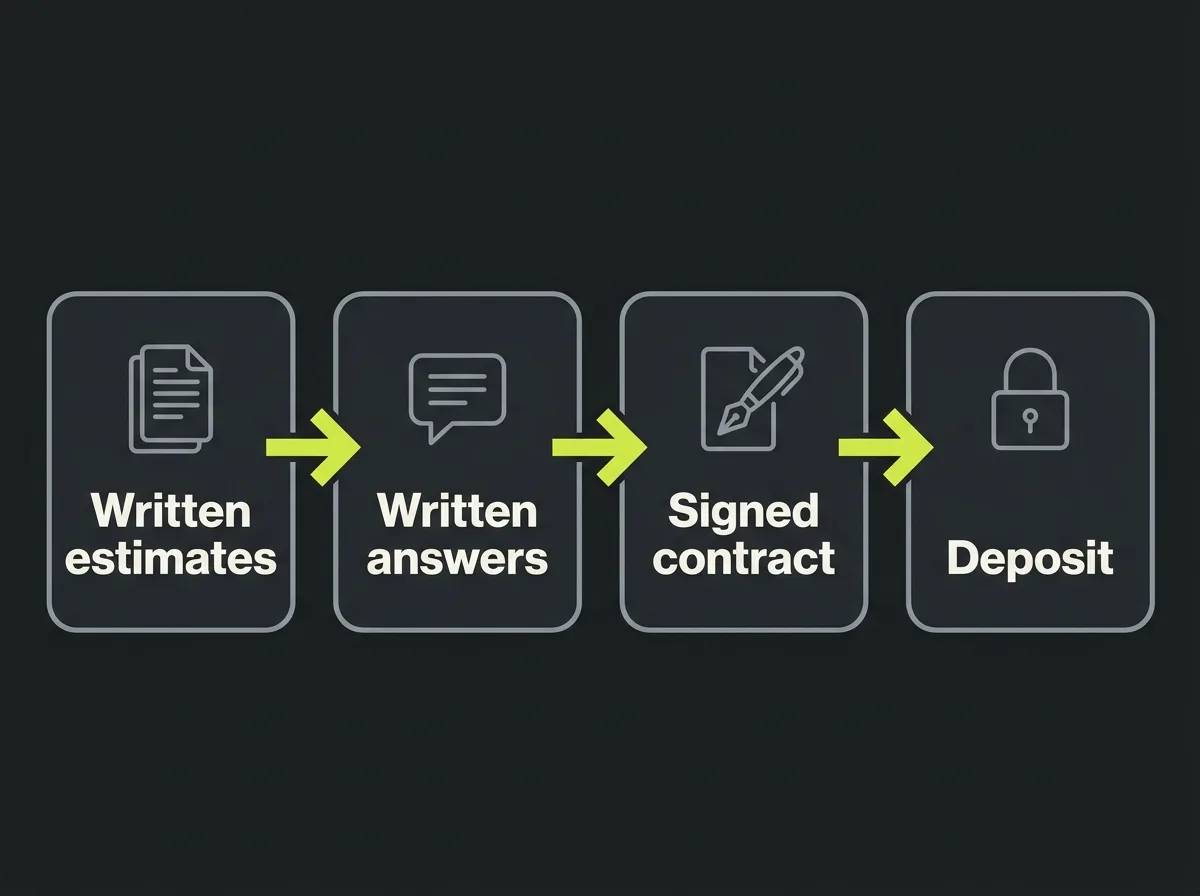
Floor coating quotes often change once a slab is ground and cracks or moisture show up. The Ontario page says new work should be discussed first, and the contractor should ask you to "approve and sign a change to the contract, including a new estimate." It also advises getting at least 3 written estimates, and it says to "never accept an estimate over the phone or without the contractor inspecting the area."
Two more protections are worth knowing. The page describes a 10 calendar-day cooling-off period for renovation contracts worth $50 or more that you sign in your home. Ontario's separate page on the Consumer Protection Act (CPA) lists "claiming that they have licences, accreditation or certification when they don't" as an example of misrepresentation.
Which questions still go to the company directly?
Anything about credentials or insurance. The Ontario page says that "workers and independent operators in the construction industry must possess workplace safety and insurance coverage," and adds, "There are some exceptions." It points readers to the WSIB (Workplace Safety and Insurance Board) to check coverage. EpoxyFloorIndex checks none of this. Its methodology says a licence claim on a profile reads "Says it is licensed," never "Licensed," and is quoted from the company's own website.
Before you hire, send each company on your shortlist the same short set of questions:
- What prep, products and number of coats does the price include?
- What does the warranty cover, for how long, and who do I call to use it?
- What are the start and completion dates, and what happens if they slip?
- How much is the deposit, and when is each later payment due?
- Will the written estimate be part of the contract?
- Do you carry WSIB coverage, and can you show it?
Written answers give you something to compare, and something to point to later if a problem comes up.
Frequently asked questions
How common are one-star reviews for GTA floor coating companies?
- They are uncommon. Across the 221 companies in EpoxyFloorIndex, Google shows 6,307 reviews, and 144 of them are one-star. Those sit on 60 companies, and 33 of the 60 have exactly one. If a company you like has a single one-star review, read it, then ask the company about it directly before you sign anything.
Should I rule out a company because it has a one-star review?
- Not on that alone. Of the 32 companies in the index with 50 or more reviews, 23 carry at least one one-star review, so a long record usually includes a bad day. Look for the same complaint repeated over time. Then ask the company, in writing, how it handled that kind of problem and what it would put in your contract.
Can a floor coating contractor charge more than the estimate in Ontario?
- Ontario's home renovation page says that when an estimate is part of the contract, the final price cannot be more than 10% over it unless you agreed to new work or a new price. The page tells homeowners to insist the written estimate goes into the contract and to sign a change before any new work starts.
What if I signed a floor coating contract at my kitchen table and changed my mind?
- Ontario's home renovation page describes a 10 calendar-day cooling-off period for renovation or repair contracts worth $50 or more that are signed in your home. You can cancel for any reason in that window. If work already started, the page says you may owe reasonable payment for work and materials, so ask for any cancellation in writing and keep a copy.
Sources
About this guide
Written by the EpoxyFloorIndex Research Team from the site's own listing data, refreshed in August 2026, and the sources listed above. EpoxyFloorIndex is free for homeowners and for the companies it lists, and its about page says the directory earns nothing today and sells no rankings, featured slots, leads or advertising. The contractor page says the site is building a paid route for work it passes on, which a company would have to agree to separately. The site's quote form says a request sent through it can be passed to one listed company in your area, and the contractor page said on 17 September 2026 that nothing had been passed to any company so far. The site does not check licences, insurance or WSIB (Workplace Safety and Insurance Board) coverage with anyone, and it does not confirm what companies or reviewers say.