Reading a Floor Coating Company's Website
Last updated: By EpoxyFloorIndex Research Team
A floor coating company's website tells you what the company says about itself. Nobody has checked it. Read each claim as a question to ask, and get the answers in writing. In the index, 199 of the 221 companies list a website. A site that fails to load is a reason to check further, not proof the firm has closed.
What can a coating company's website show you?
It shows the company's own description of its work, in its own words. That is useful for building a shortlist, but it is still the company talking. The index data shows how often that description exists. Of the 221 Greater Toronto Area (GTA) companies listed, 199 have a website on file and 22 do not.
EpoxyFloorIndex marks a profile when the company's own site describes floor coating work. Its methodology page says this "currently holds for 156 of our 221 listings." The same page adds: "It means the business says so, in its own words, on its own site. It does not mean we confirmed the company does the work." A missing mark is not a warning either. The page calls it "silence, not evidence against a business."
So a website answers one early question well: does this firm say it does the kind of floor you want? Everything after that, from price to warranty, needs a paper trail.
How much is "licensed and insured" on a website worth?
It is worth a follow-up question and nothing more until you see a document. EpoxyFloorIndex reads these sentences off company sites and prints them with a hedge. The methodology page says each one is printed "as 'Says it is licensed' and never as 'Licensed'". It also says "Nobody called a registry, nobody checked a licence number, and nothing here has been confirmed with anyone."
The trade itself makes the word slippery. The same page says "Floor coating in Ontario has no licensing regime and no accreditation body of its own". It adds that when every company website on file was fetched, "exactly one mentioned an accreditation." If a site says "licensed", ask which licence it means and who issued it.
Some of the wording is not a claim at all. The methodology page warns that "'bonded' usually means glue here", since coating pages describe a primer that bonds to the slab. Other pages tell the reader to "look for a provider that is fully insured", which the page calls "advice to you, not a claim about themselves." Of the 59 licence and insurance sentences the site's crawl found, the page says 9 were dropped for those two reasons.
What to ask for instead:
- Insurance. Ask for the insurance certificate itself, with the company's name and the dates of cover on it.
- Workplace injury coverage. Ontario's page on home renovations says construction workers and independent operators "must possess workplace safety and insurance coverage", with some exceptions. It tells homeowners to contact the WSIB (Workplace Safety and Insurance Board) to check coverage.
- Complaints. The same Ontario page suggests searching the business and its operator on the Consumer Beware List, a provincial list of complaints and charges against businesses.
What should a warranty line on a website make you ask?
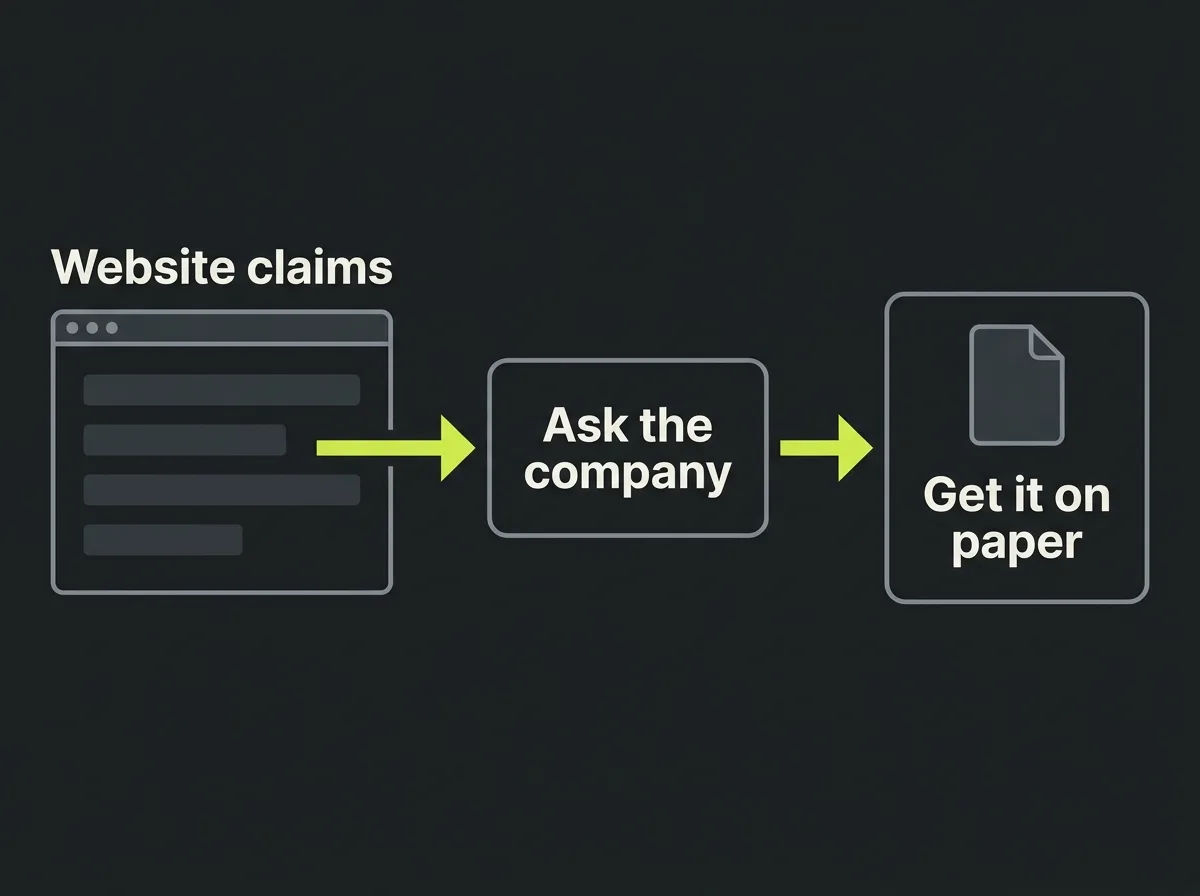
It should make you ask for the full warranty terms on paper. Warranty wording is common on these sites. Of the 156 companies whose stored website text is long enough to read, 49 mention the word "warrant" somewhere. A mention can be a promise, a page heading or a line of advice, so the count shows how often the topic comes up, not what any company offers.
The index holds no warranty terms for any company, so the questions go to the firm. Ontario's renovation page lists "a clear description of any warranties" among the items a contract should include. It also says to "check warranties and guarantees carefully", and adds that "the contractor's reputation and length of time in business are more important than a warranty or guarantee."
One GTA seller's own guide goes further. Polished Floors, which sells coating work and is itself listed on EpoxyFloorIndex, says "Anything advertised as \"lifetime\" without a clear written list of what is covered is marketing language, not a real warranty." Ask each company four things:
- Who holds the warranty: the installer, the product maker, or both?
- What does it cover, such as peeling, lifting or yellowing?
- What cancels it, such as skipped care or a damp slab?
- How do you make a claim, and to whom?
What does "free estimate" on a website promise?
It promises that the company will price the job without charging for the visit or the quote. It does not promise what the price will include. Free estimate or free quote wording shows up in 88 of the 156 stored company sites with readable text, more than half of them.
What matters is the estimate you receive. Ontario's renovation page says "Always get at least 3 written estimates from different contractors." It says estimates "should have a description of the work to be done, an itemized list of products and services and their prices." It also warns: "If something isn't written in your contract, you may not get it."
For what a coating quote should list line by line, the live guide on reading an epoxy floor quote in Toronto covers it in detail.
What does a stated service area tell you?
It tells you where the company says it wants to work. That may be wider or narrower than where it is based. The site's data shows that 73 companies state a service area on their own website. Some name a single city, and some name a whole region or province.
The area on an EpoxyFloorIndex profile comes from the company's map record, not from its website. The two can differ, and 19 records carry no area at all. If your street sits at the edge of a company's stated area, ask two things. Will it travel to you? Does the distance change the price or the schedule?
Does a dead website mean the company has closed?
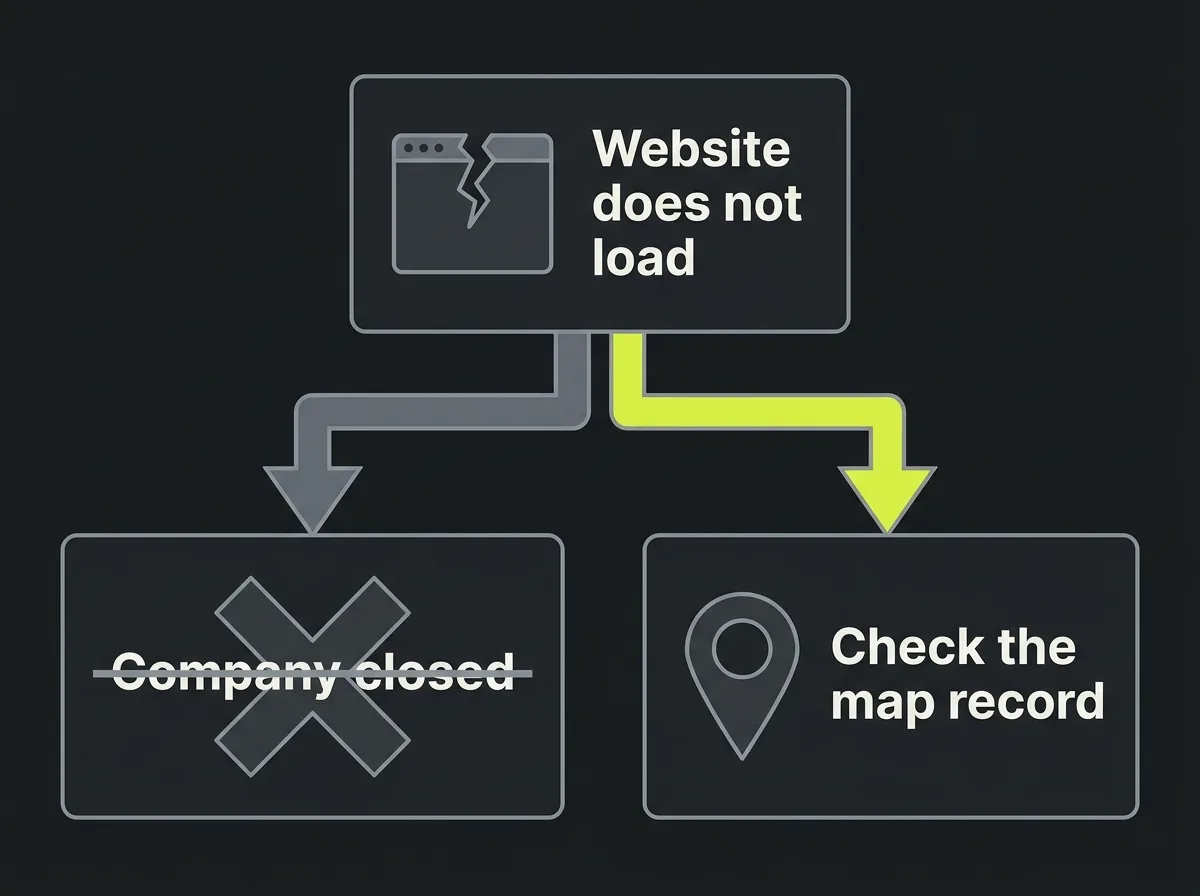
No. A website that fails to load is a fact about the web address, and the company may still be trading. The site's own website-check records show why. On 31 August 2026, a crawler (a program that fetches web pages) tried every company website on file. Here is what it found across all 221 records:
| What the check found on 31 August 2026 | Records |
|---|---|
| The site answered normally | 167 |
| No website on file | 22 |
| The web address pointed nowhere (the domain did not resolve) | 11 |
| The site answered with a refusal or not-found error (a 400-range code) | 9 |
| The connection failed | 4 |
| The site's robots file asked crawlers to stay out | 4 |
| A server error in the 500 range | 3 |
| The site took too long to answer | 1 |
A robots file is a note on a website that tells crawlers which pages to skip. Of the 9 refusal or not-found errors, 7 were the site turning the crawler away (a "forbidden" or "too many requests" reply), not a missing site. The methodology page says plainly: "A website that refuses our crawler is not a dead website."
A separate check on 26 August 2026 led the site to withhold 20 website links: 19 addresses that did not answer and 1 that showed a placeholder page. Of those 19, 2 answered normally when the crawler tried again five days later. Of the 20 companies involved, 17 still carry a Google rating. The methodology page says "a lapsed domain is not evidence anyone stopped trading", and "nothing on this site has been checked for closure." It also tells readers to "Check the company's own Google record before you rely on it."
What if a company has no website, or only social media?
Look at what else is on the record, then ask for the same documents. Of the 221 companies, 101 link at least one social media profile from their own website. Photos of finished floors on those pages show what a company chooses to post. They do not show who did the work or when.
The index reads social links only from company websites, so it holds none for the 22 companies with no website on file, yet 18 of them carry a Google rating. A missing website says little about the work. For those firms, reviews and a written estimate carry more of the load. Every profile on EpoxyFloorIndex carries a request form, which the about page describes as the route to a company that has not claimed its listing.
A routine for reading any coating company's website
Use the website to decide whether to ask for a quote, then move the real questions onto paper. Start from the full list of companies or a category page, and for each firm:
- Check the work described. Does the site describe the floor you want, in its own words?
- Note every claim. Write down each licence, insurance, warranty or "since" line as a question to ask.
- Read the service area. Confirm the firm says it works where you live.
- Ask for documents. Request the insurance certificate, the WSIB answer and the warranty terms in writing.
- Get written estimates. Compare them only once each one lists the same work.
- Treat a dead link with care. Check the company's own Google record before you rule it out.
What a directory listing and a Google label can and cannot tell you is covered in the live guide to vetting a GTA floor coating contractor.
Frequently asked questions
Can I trust a floor coating website that says "licensed and insured"?
- Treat it as the company's own sentence, not a checked fact. EpoxyFloorIndex's methodology says floor coating in Ontario has no licensing regime of its own, so ask what licence is meant. For insurance, ask for the certificate. For workplace injury coverage, Ontario's renovation page points homeowners to the Workplace Safety and Insurance Board (WSIB) to check it.
What should a warranty on a coating company's website include?
- The website line is only a starting point. Ontario's renovation page lists "a clear description of any warranties" among the things a contract should include. Ask who holds the warranty, what it covers, what cancels it, and how to make a claim. Then make sure those terms appear in the signed contract, not only on the website.
Why is a company's website link missing from its EpoxyFloorIndex profile?
- The site withholds a link when the address did not answer or showed a placeholder page on 26 August 2026. That happened to 20 addresses. The listing stays on the site, and the site says nothing was checked for closure. Search the company name on Google Maps and look at its own record before you decide it has gone.
What if a floor coating company has no website at all?
- It can still be a working business. In the index, 22 records have no website on file, and 18 of them still carry a Google rating. Look up the company's own Google Maps record for a way to reach it, then ask for the same written estimate and warranty terms you would ask of any other firm.
Sources
- EpoxyFloorIndex, How EpoxyFloorIndex ranks companies (methodology, updated 11 September 2026)
- EpoxyFloorIndex, About EpoxyFloorIndex (updated 11 September 2026)
- Government of Ontario, Your rights when starting home renovations or repairs
- Polished Floors, Garage Epoxy vs Polyaspartic in Toronto Winters (2026)
About this guide
Written by the EpoxyFloorIndex Research Team from the site's own listing data, refreshed in August 2026, and the sources listed above. EpoxyFloorIndex is free for homeowners and for the companies it lists, and its about page says the directory earns nothing today and sells no rankings, featured slots, leads or advertising. The contractor page says the site is building a paid route for work it passes on, which a company would have to agree to separately. The site's quote form says a request sent through it can be passed to one listed company in your area, and the contractor page said on 17 September 2026 that nothing had been passed to any company so far. The site does not check licences, insurance or WSIB (Workplace Safety and Insurance Board) coverage with anyone, and it does not confirm what companies or reviewers say.