Coating a Toronto basement floor, and why the moisture test decides the rest
Last updated: By EpoxyFloorIndex Research Team
The slab is a wick, not a barrier
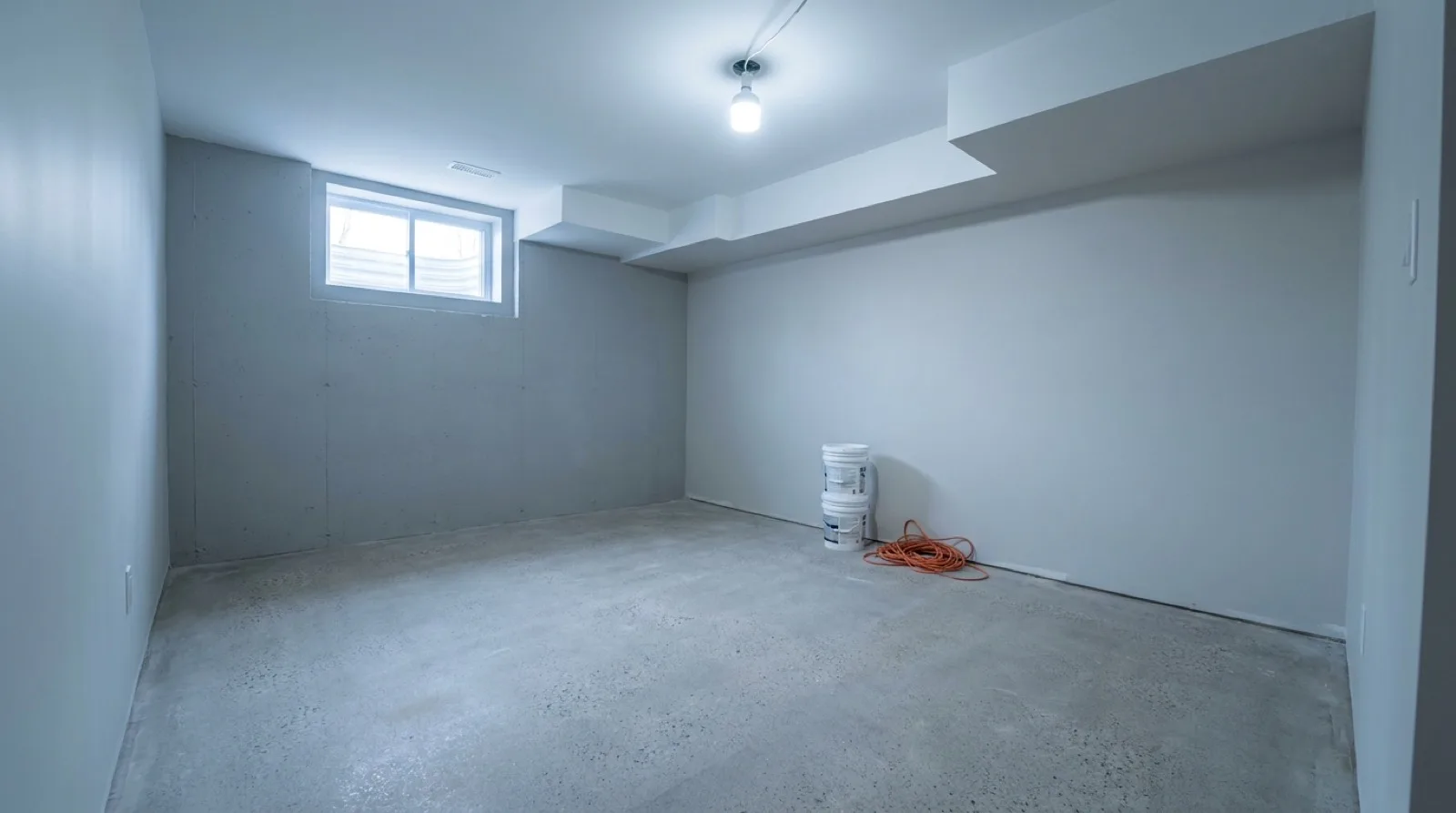
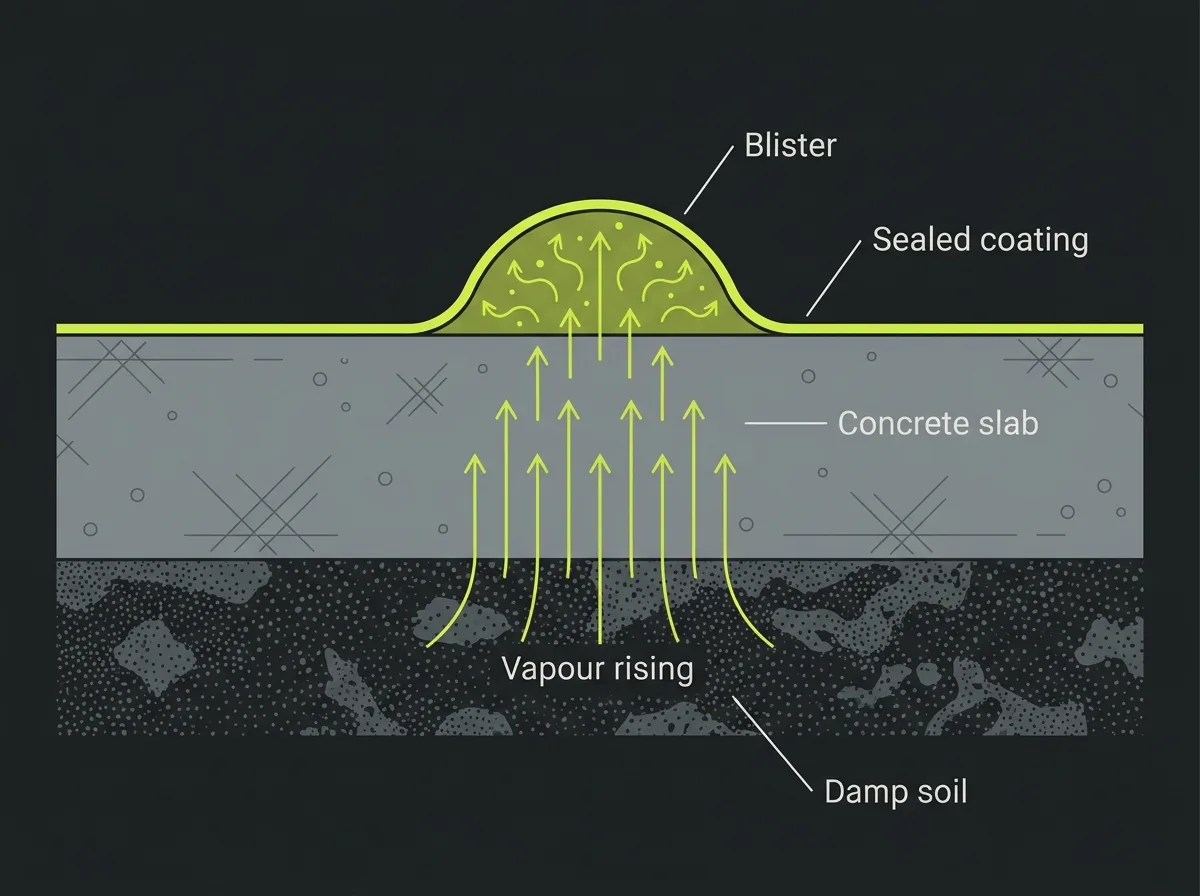
Concrete looks solid and behaves like a sponge. A basement slab sits on soil that holds water, and that water travels up through the pores of the slab as vapour whenever the air in the room is drier than the ground underneath. Nothing about that is a defect. It is what a slab poured on grade does every day of its life, and in a bare basement nobody notices, because the vapour leaves into the room and the room carries it away.
A coating changes the arrangement. Epoxy and polyaspartic films are close to vapour tight, so once one is down, the moisture that used to leave through the surface has nowhere to go. It gathers under the film. Where the pressure it builds is greater than the bond between the film and the concrete, the film lifts, and it lifts as blisters in the middle of the floor rather than as a tidy edge you could trim.
GLI Epoxy Flooring states the Toronto version of this directly: moisture matters more in a basement than in any other room, Toronto basements hold humidity, a vapour barrier adds to material cost but is not optional if the floor is to stay bonded, and skipping the moisture test is the main reason cheap installs bubble, peel and fail within a year. That single paragraph is the reason a basement quote has to be read differently from a garage quote for the same square footage.
The test that settles the argument before anyone grinds
The useful thing about slab moisture is that it is measurable. A contractor can test the slab before quoting the barrier, and the result either justifies the add-on or removes it from the price. A basement quote that names a moisture barrier without any test behind it is a guess in your favour or against it, and you cannot tell which.
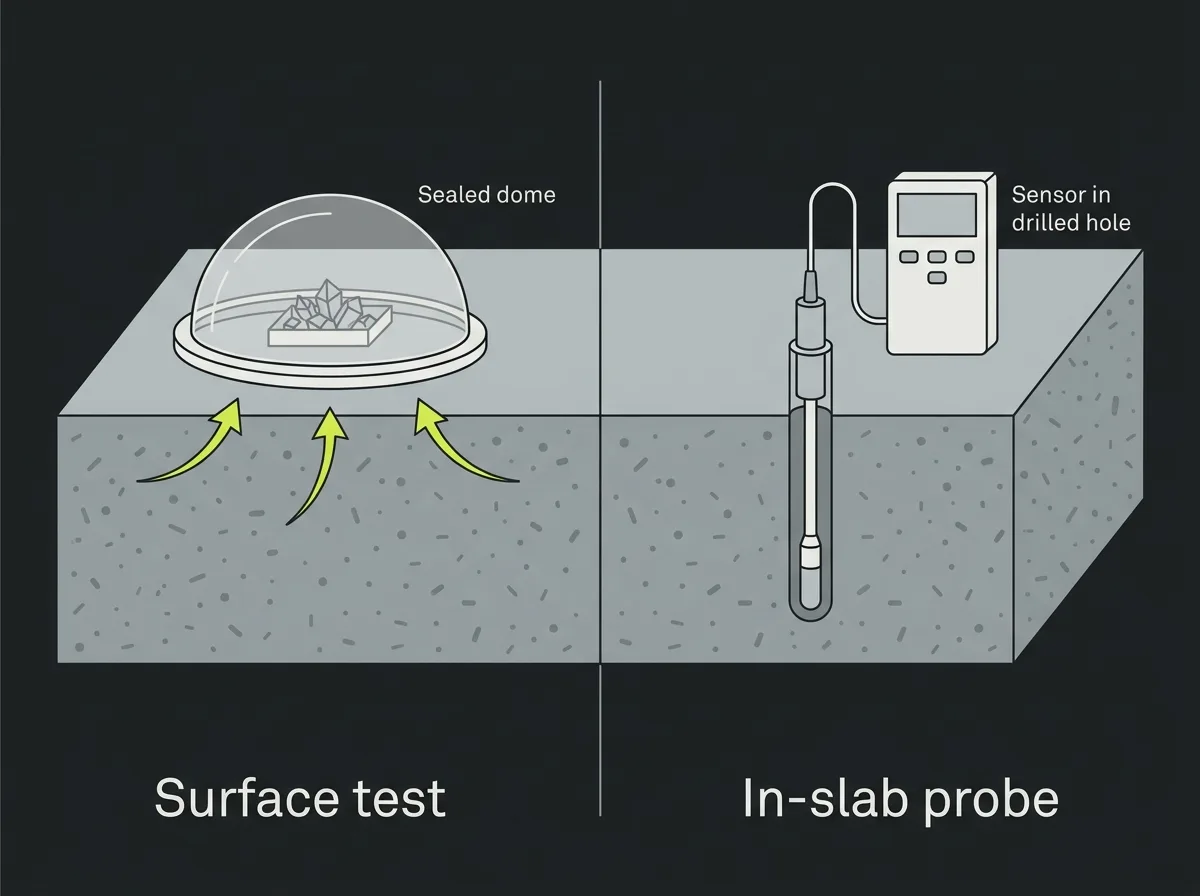
There are two common ways to ask the slab the question. One measures how much moisture leaves a marked area of the surface over a set period. The other buries a probe in a drilled hole and reads the relative humidity inside the slab itself once the hole has settled. The second is the one most specifications lean on now, because a surface reading changes with the weather in the room while an in-slab reading describes the concrete.
What matters for a homeowner is far simpler than the method. Ask whether the slab was tested, ask what the reading was, and ask what the coating manufacturer's limit is for the system being proposed. If those three answers exist, the barrier line on the quote is an engineering decision. If they do not, it is a sales decision, and it can go either way.
What a basement floor costs before the moisture line
Published Toronto pricing for basement work sits below garage pricing on a per square foot basis, because the surface is usually flatter, cleaner and easier to work. GLI Epoxy Flooring lists basement epoxy flooring in Toronto at $5 to $9 per square foot, with a metallic basement finish at $9 to $12. Canadian Concrete Surfaces lists basement epoxy across Ontario at $3 to $7 per square foot.
Project totals from the same market are easier to check a quote against. GLI Epoxy Flooring lists a 1,000 square foot basement with a flake system and a moisture barrier at $5,000 to $9,000, and a 600 square foot basement with a metallic finish at $5,400 to $7,200. Epoxy Dudes prices a small basement of 400 to 500 square feet at $2,800 to $3,500, a medium basement of 600 to 800 square feet at $4,200 to $5,600, and a basement over 1,000 square feet from $7,000. Toroo Epoxy Coatings gives a wider band of $2,000 to $6,500 for a basement floor between 500 and 1,500 square feet.
One published figure is worth handling carefully. Armour Guard quotes $1,200 to $20,000 for an epoxy basement floor, and the source itself says the range depends on your basement size and how much of the floor you intend to coat. That is a total project range covering everything from one room to a full footprint, not a rate, so it does not compare directly with the numbers above without knowing the scope behind it.
Polyaspartic is also on the table below grade. Quick Coat prices a 600 square foot basement room with a polyaspartic system at $1,800 to $7,200, a spread that the source attributes to scope of work and site conditions rather than to the chemistry.
The barrier is a line item, not a courtesy
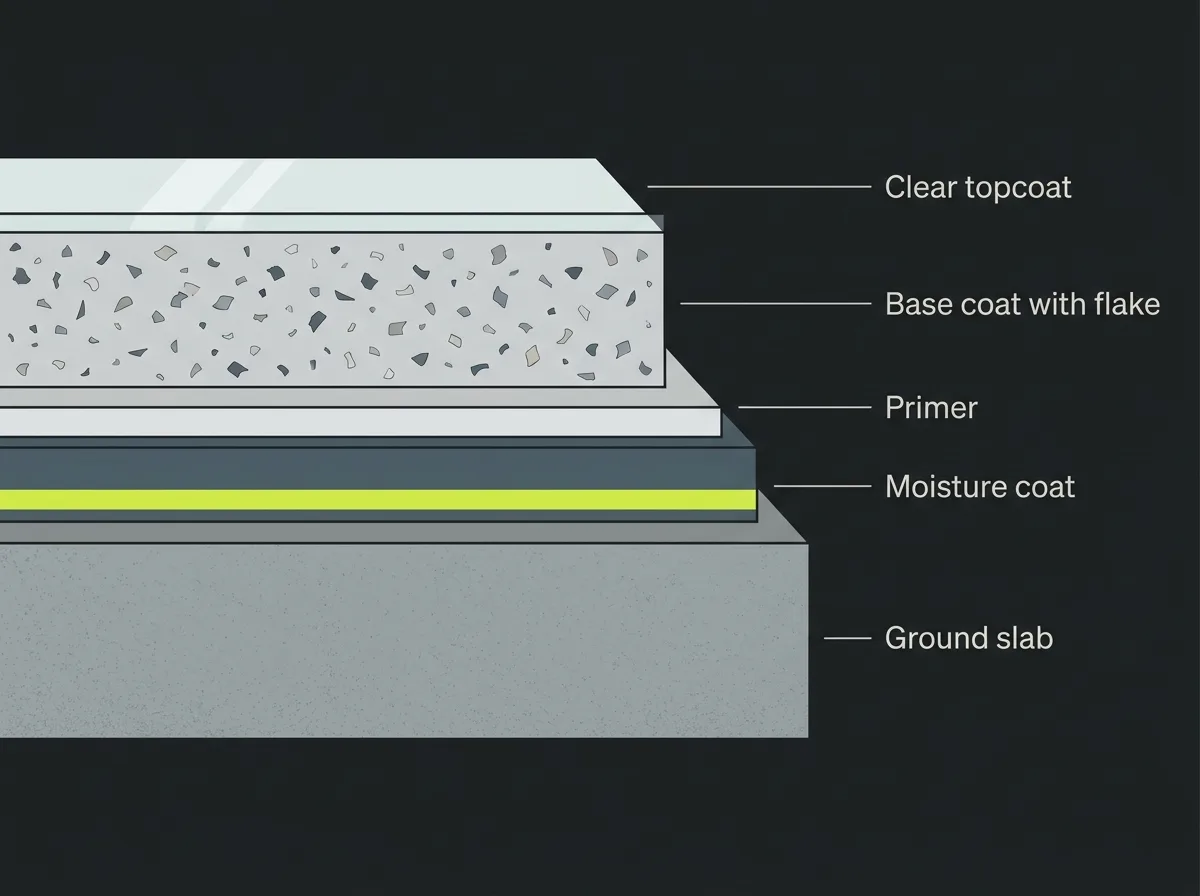
Where a slab tests wet, the fix is a moisture mitigation layer that goes down before the coating system and holds the vapour back well enough for the film above it to stay bonded. It is a real material, applied as its own step, and it is priced that way.
SurfacePro Epoxy Flooring prices a moisture vapour barrier for slabs under high hydrostatic pressure at $2.00 to $4.50 per square foot as an add-on. On a 1,000 square foot basement SurfacePro's rate comes to $2,000 to $4,500 on top of the coating, which is why it tends to disappear from a quote that is competing on the headline number. GLI Epoxy Flooring, Armour Guard and Canadian Concrete Surfaces all name moisture control and vapour barriers as the leading basement specific cost driver, so a basement quote with no moisture line anywhere on it is describing a different job from one that has it.
Canadian Concrete Surfaces also lists an antimicrobial formulation that resists mould and bacteria growth at roughly $1 per square foot above standard pricing. In a basement that has taken water before, that is a small number against the reason you are coating the floor in the first place.
Removal is the other line people forget
Most basements being coated are not bare. There is carpet, or laminate, or a floating subfloor, or tile that was set on the slab twenty years ago and has been half loose since. All of it has to come off before anyone can grind, and the removal is separate work with a separate cost.
Canadian Concrete Surfaces prices existing flooring removal and disposal for finished basements at $2 to $4 per square foot. On a 1,000 square foot basement Canadian Concrete Surfaces' rate comes to another $2,000 to $4,000, in the same order as the moisture barrier, and equally easy to leave out of a quote written from a photograph.
Ask who is doing the removal and who is paying for the bin. A quote that assumes you will strip the floor yourself is a legitimate way to save money, but only if you know that is what you agreed to.
What the index can and cannot tell you here
This site lists 221 floor coating companies working across the Greater Toronto Area. What each record holds is what a public business listing holds: a name, a location, a phone number for 215 of them, a website for 199, a category label and, for 173 of them, a rating carried by at least three reviews. Those 173 average 4.87 out of 5, and 83.2 percent of them sit at 4.8 or higher.
What no listing holds is whether a company tests slabs before quoting, which moisture mitigation products it carries, or what happened on the last basement it coated. The index cannot rank companies on that, and it does not try. It is a starting list, and the moisture questions above are what turns a list into a shortlist.
There is one alternative worth knowing about before you commit. If a slab is in good condition and the room does not need a film at all, polishing and sealing the concrete is a different way to finish it, and 40 of the 221 companies here are recorded as doing that work as well. A slab that fights a coating does not always need a coating.
Frequently asked questions
How much does it cost to coat a basement floor in Toronto?
- GLI Epoxy Flooring lists basement epoxy flooring in Toronto at $5 to $9 per square foot, and prices a 1,000 square foot basement with a flake system and moisture barrier at $5,000 to $9,000. Epoxy Dudes prices a small 400 to 500 square foot basement at $2,800 to $3,500 and a basement over 1,000 square feet from $7,000. The spread between sources mostly reflects finish tier and whether moisture mitigation is included.
Does a Toronto basement floor need a moisture barrier?
- It needs a moisture test first, and the test decides. GLI Epoxy Flooring says moisture matters more in a basement than in any other room, that a vapour barrier is not optional if the floor is to stay bonded, and that skipping the moisture test is the main reason cheap installs bubble, peel and fail within a year. Where the slab tests wet, SurfacePro Epoxy Flooring prices the barrier at $2.00 to $4.50 per square foot as its own line.
Why do basement coatings blister when garage coatings usually do not?
- A basement slab sits on damp soil and gives off vapour into the room. A coating is close to vapour tight, so the moisture that used to leave through the surface collects under the film instead, and where it builds more pressure than the bond can hold, the film lifts as blisters. A garage slab is generally drier, better ventilated and less exposed to ground moisture, so the same system behaves differently there.
What does it cost to remove the old basement flooring first?
- Canadian Concrete Surfaces prices existing flooring removal and disposal for finished basements at $2 to $4 per square foot. That is a separate line from the coating and it is easy to leave out of a quote prepared without a site visit. Confirm whether removal and disposal are included, and who is paying for the bin, before you compare two prices.
Can polyaspartic be used on a basement floor?
- Yes. Quick Coat prices a 600 square foot basement room with a polyaspartic system at $1,800 to $7,200, and attributes that wide spread to scope of work and site conditions rather than the material. Polyaspartic cures far faster than epoxy, which matters in a finished basement you want back in use, but it does not remove the need for moisture mitigation under it.
Where these figures come from
- A Toronto basement epoxy floor is priced at $5 to $9 per square foot, a metallic basement finish at $9 to $12, a 1,000 square foot basement with a flake system and moisture barrier at $5,000 to $9,000, and a 600 square foot metallic basement at $5,400 to $7,200.GLI Epoxy Flooring: Epoxy Flooring Cost Toronto (Pricing Guide)
- A moisture vapour barrier for a slab under high hydrostatic pressure is priced separately at $2.00 to $4.50 per square foot on top of the coating.SurfacePro Epoxy Flooring: Epoxy Flooring Cost Toronto (2026 Garage Pricing Guide)
- Removing and disposing of existing flooring in a finished basement adds $2 to $4 per square foot, and an antimicrobial formulation adds roughly $1 per square foot.Canadian Concrete Surfaces: Epoxy Flooring Cost in Ontario (2025 Guide)
- Toronto basement projects by size are priced at $2,800 to $3,500 for 400 to 500 square feet, $4,200 to $5,600 for 600 to 800 square feet, and from $7,000 above 1,000 square feet.Epoxy Dudes: Epoxy Flooring Cost in Toronto (2025)
- Of the 221 companies in this index, 215 publish a phone number, 199 publish a website, 173 carry a rating backed by at least three reviews, those 173 average 4.87 out of 5 with 83.2 percent at 4.8 or higher, and 40 are recorded as also doing polished and sealed concrete. Counted from this site's own dataset.epoxyfloorindex dataset, 221 Greater Toronto Area floor coating companies